

Paris tells a story with a gaze that gazes far, as if he is seeing the bridge itself.
“To reach Kenti, we have to pass through Palang Liwa, a swinging bridge. If we fall, we will be eaten by dekot fish and end up in hell,” he whispered softly.
I sat in front of him in Long Ranau, Tubu River, Malinau, North Kalimantan, that evening. The technical verification team from the Ministry of Environment and Forestry had just finished examining the boundaries of customary territories that Paris had been fighting for almost four and a half years. Outside, the forest still stood thick. Inside this room, the 58-year-old man told stories about paradise.
Kenti is the Punan people’s term for paradise. Paris learned the story from a living oral history fragment passed down through generations: in the old days, one of their ancestors died, traveled to Kenti, but because they still had unfinished worldly matters, they were sent back to live again in a coffin. From inside the coffin, they told about the path to Kenti. This tradition also led the community to call back the spirit of the deceased after three days of burial through a small hut located 50 meters from the grave. If the food served was “touched” by the spirit, they believed the deceased had safely arrived in Kenti.
I listened to Paris telling stories and thought: for almost four and a half years, he himself felt like he was standing on that swinging bridge. Not to reach the paradise of the dead, but to legally secure his ancestral land before it was too late.
***
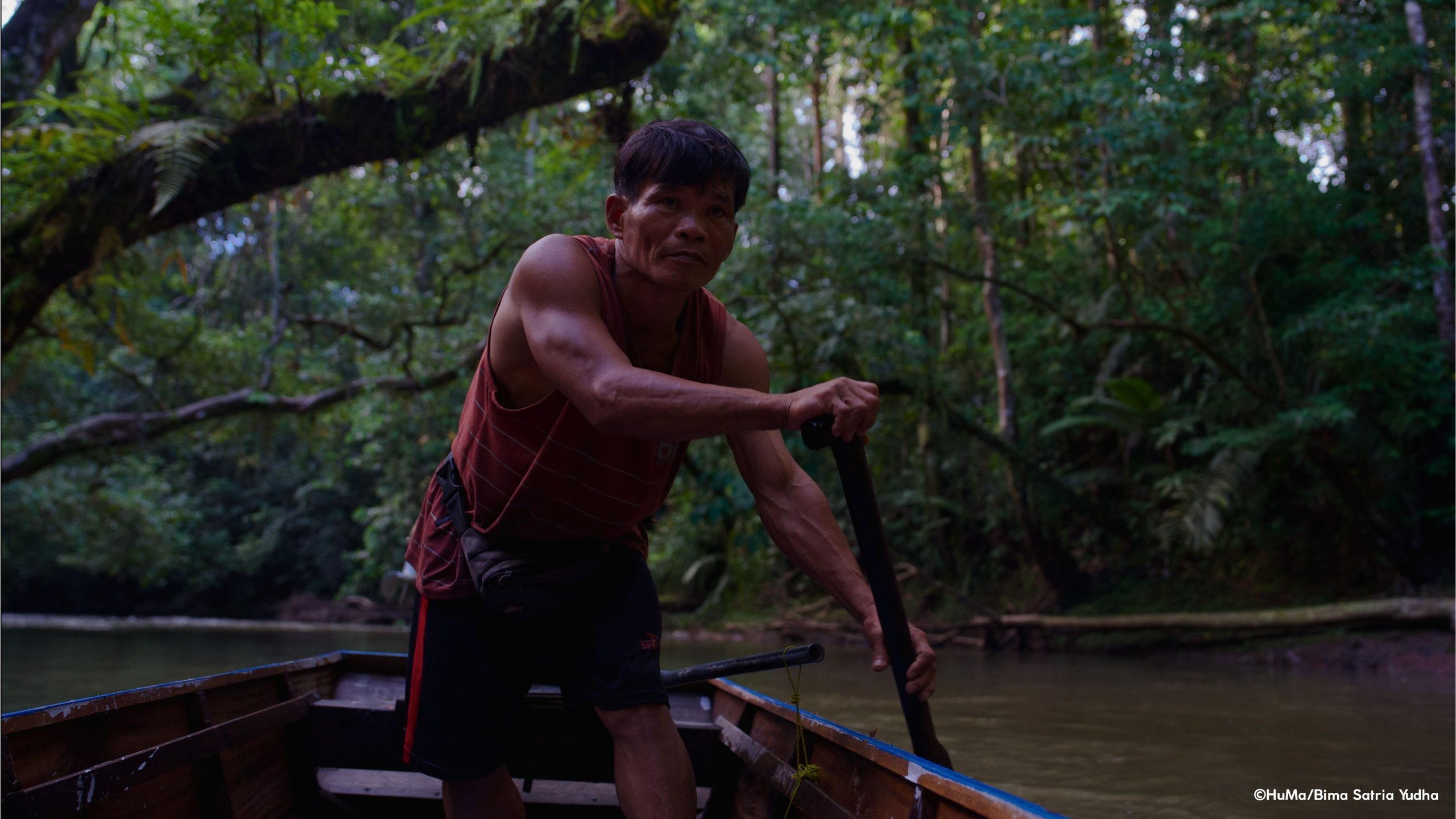
Paris is also known by his original Dayak name, Wei, which means Rattan. He was born under the lush rattan trees in the midst of this wilderness. Today, he is the Traditional Chief of Sungai Tubu Subdistrict.
“For us, this forest is like our mother’s breast milk,” he said. In the Punan language, telang otah ine means mother’s breast milk. “It means preserving the forest makes the earth safe. From ancient times until now, we live and depend entirely on this mother’s breast milk.”
For me, coming from the city, that expression sounded like a metaphor. But as Paris explained the details, I realized it was not a figure of speech. When crop failures occur, the forest always provides sago. When they need containers to carry wood or hunting results, rattan is woven into anjat and bekang. Illumination at night comes from forest resin torches. Since ancient times, the Punan Tubu community has never moved from the Tubu River because they didn’t need to.
“We catch fish enough to eat, hunt animals enough for the family. We don’t like to destroy without reason. In Long Ranau, our lives are safe and comfortable without being burdened by costs, because everything is in the forest,” he narrated. Even high-value agarwood is managed with communal principles. If a resident is fortunate enough to obtain it and sell it in Malinau, the proceeds are enjoyed together, including being distributed free of charge to widows and elderly widowers who are no longer able to work.
Their spiritual connection with nature is so strong, guided by natural signs and ancestral rituals. Paris mentioned that when walking in the forest and a bird flies directly in front of their chest, they choose to retreat as it is a signal of danger. If they hear a good sound, the journey continues peacefully.
Then Paris talked about Loreh.
“Look over there, not far away. Nowadays there are coal mines and timber companies. The indigenous people are oppressed, they have nothing left for their descendants. The river is murky from diesel, fish die,” he said with a bitter tone. He saw a similar situation in the Tana Tidung Regency, where the living space of the community was encroached upon by industrial concession areas.
I nodded. From the journey to Long Ranau, I had already seen the traces: changing colors of former land, rivers no longer clear in more open areas

0 Comments
Leave a Reply