

Written by: Etik Oktaviani
On the shores of Halmahera, far from any courthouse, a training method seeks to transform ordinary villagers into People’s Legal Advocates.
That morning, Ikal’s hands trembled.
Not because of a fever, nor because of the sea breeze slipping through the gaps in the walls of the learning hut. The young man from Maba Pura was trembling because he had been asked to stand up and speak in front of twenty people he had only met the day before. Bang Enal, a calm facilitator who rarely seemed at a loss, asked him to introduce himself on the first day of the People’s Legal Advocacy School. Ikal stood. His mouth opened. His voice cracked midway through.
Three days later, Ikal stood again.
This time, it was not to introduce himself. He spoke about land. About his village. About a promise he would carry home. “I will return to my village and tell the entire community of Maba Pura that we must defend our land. We must not allow ourselves to be trampled on our own land.” His voice did not crack. His hands did not tremble. And the twenty people gathered around the portable lamp listened in a heavy silence.
I witnessed it all. And I am still searching for the right words to describe what changed between those two moments.
Eight Hours to the Margins
The journey to Bicoli Village, Maba District, East Halmahera, is the kind of journey that forcibly teaches patience. Three and a half hours in the air, forty-five minutes on a speedboat cutting across the strait, followed by seven to eight hours of overland travel on winding roads that make your stomach want to protest. Our driver handled the vehicle with an enthusiasm that reminded me of a Formula One racer. I chose to close my eyes.
Occasionally, my eyelids opened on their own. And every time they did, I saw the silhouettes of heavy machinery scattered along Halmahera’s coastline through the window. Mines. Kak Martje, my travel companion in the seat beside me, told me to go back to sleep before my motion sickness spread to the other passengers. I obeyed.
Around nine o’clock in the evening, Eastern Indonesia Time, we arrived at Fala Lamo. Darkness. No welcoming lights. There was no electricity yet. What there was, however, was sound: frogs, and something flowing. I assumed it was a river.
“Not a river. That’s beside Waybibil Beach,” said a middle-aged woman I had not yet met, speaking in a distinct eastern Indonesian accent, when I asked Kak Martje.
Not long afterward, Bang Jeff, whose full name is Jefferson and who serves as the Director of Fala Lamo, invited us to take a plate. Women who seemed to have appeared from nowhere had prepared grilled fish with dabu-dabu sauce, fried fish, stir-fried papaya with sweet soy sauce, rice, and cassava. After eight exhausting hours of travel, the meal felt like a reward I did not deserve. I finished every bite.
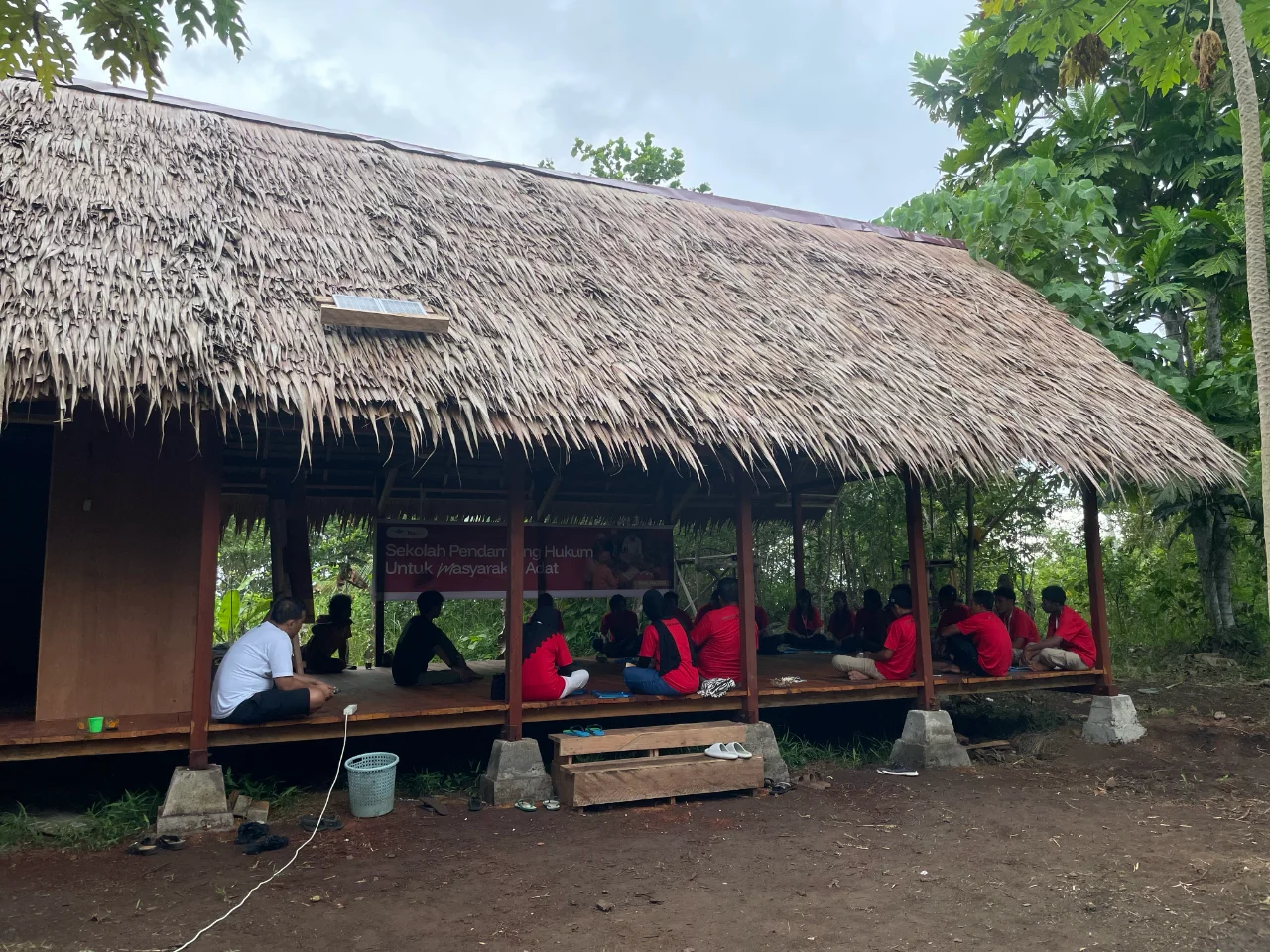
This is the People’s Legal Advocacy School, or SPHR: a three-day training program designed to equip ordinary citizens, particularly Indigenous Peoples, with enough legal knowledge and skills so that they are not easily deceived on the ancestral lands they have inherited.
Putting Away the Teaching Materials, Starting a Conversation
The next morning, before the classes even began, the method was already being tested.
We lined up to use the only available toilet. While waiting our turn, Bang Rais, the program supervisor, Kak Martje, Bang Enal, and I discussed the learning plan. Bang Ein and Kak Rahma, Fala Lamo staff members who had generously given up their room for us, shared news that changed everything: almost all of the participants had never attended any formal education or training program before.
Then we turned on the projector. Its screen appeared yellowed.
The decision was made quickly and without drama: all the prepared teaching materials were folded up and put away. Lectures were minimized. In their place came group discussions, role-playing, and participant-led presentations. Not because the projector was broken, but because that was how it should have been from the start.
SPHR is built upon a simple but often forgotten belief: legal knowledge cannot be injected from the outside into people’s heads. It must grow from within, from experiences already alive in the participants’ bodies and memories. The facilitator’s role is not to fill an empty vessel, but to ignite what is already there.
Day One: Recognizing What Already Exists
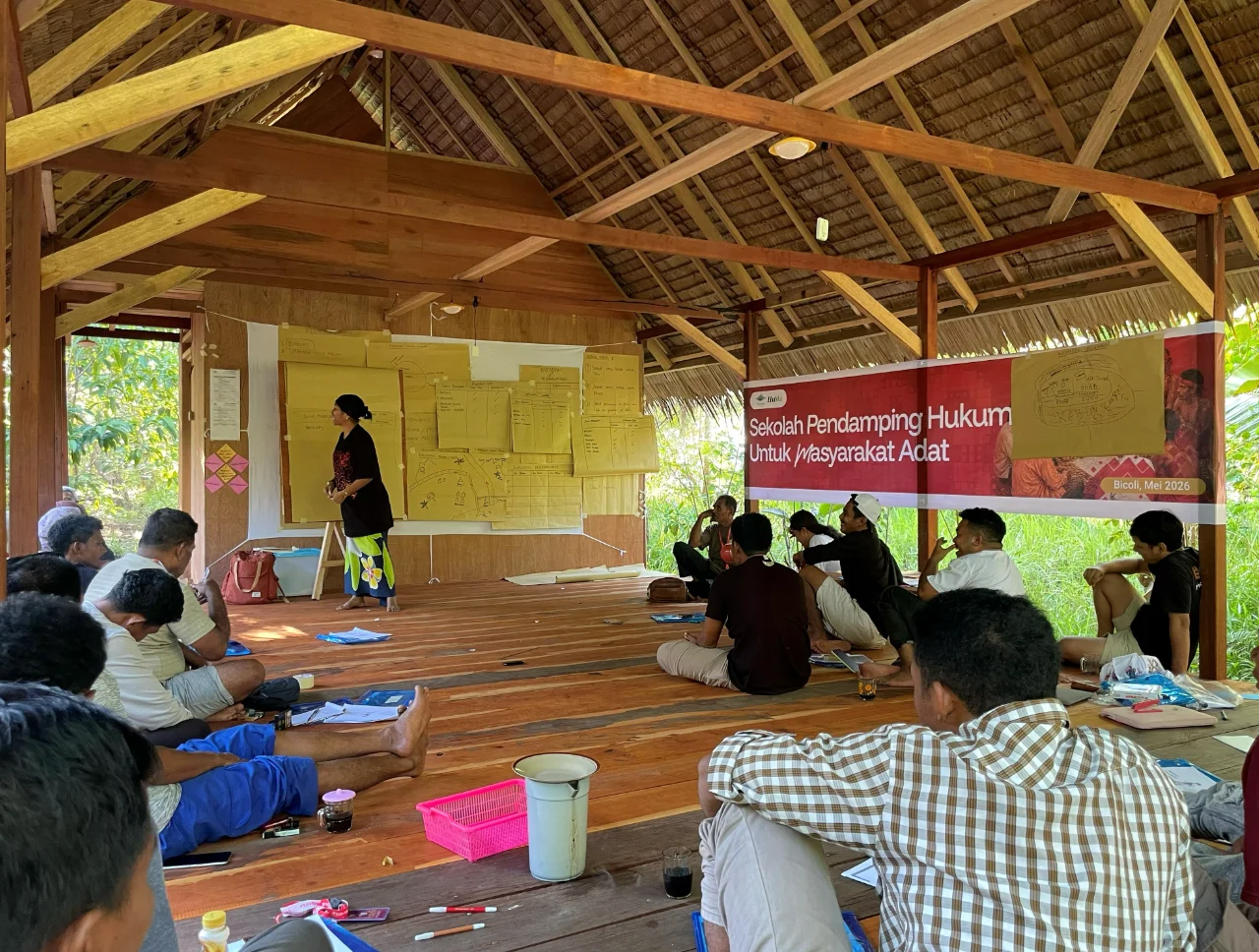
At around half past nine in the morning, Bang Jeff opened the forum and explained the goals of SPHR. Twenty participants sat in a circle, coming from places whose names I gradually learned by heart: Sangaji Bicoli, Sangaji Maba, North Halmahera, and North Maba, including four members of the O’fongana Manyawa Indigenous community.
Bang Enal took over. He began not with content, but with three questions: How are you feeling today? What interesting thing have you experienced recently? And what is the most embarrassing thing you have ever done? The third question made several participants laugh awkwardly. But that was precisely why it worked. A room that had begun silent and stiff suddenly filled with voices. Strangers became familiar faces. Even Ikal, whose hands had trembled when he first stood up, began to lift his head with confidence.
Then Bang Enal turned to those of us who were not participants and said, “This session belongs to the participants, so the rest of us should know our place.” One by one, we stepped back.
When it was my turn to lead the session on “Understanding Law,” I was still wondering what approach would make everyone feel comfortable. In the end, I chose not to begin with answers, but with questions. What rules exist in your village? Who enforces them? What are the consequences if they are broken?
Participants were grouped according to their region of origin and began discussing. The results surprised me. The group from North Maba presented their findings entirely in the language of the O’fongana Manyawa Indigenous community, confidently and fluently. At that moment, I realized something I should have known all along: they had not come empty-handed. They carried legal systems that had existed long before this training was ever designed. My task was not to teach them, but to help them see that what they practiced every day was legitimate law—equal in status and often in direct interaction with state law.
After lunch, Bang Rais took over for the session on “Mapping Legal Systems.” Full stomachs and the coastal breeze of midday created their own challenge, and Bang Rais knew it. People call this injury time—that moment when the body wants to rest but the program still demands attention.
Rather than fighting that reality, Bang Rais used it to his advantage. The conceptual presentation was brief and quickly shifted into discussion. He introduced what academics call legal pluralism, a term that sounds complex but is deeply rooted in everyday life. In Indonesia, three legal systems operate simultaneously and often collide: state law written in legislation, religious law derived from sacred texts, and customary law that lives through community practice passed down through generations. They do not always coexist peacefully. They interact, compete, negotiate, coexist, and challenge one another. For Indigenous communities whose lands are increasingly targeted by the nickel industry, understanding these dynamics is not merely theoretical. It is a matter of survival.
Each group then mapped how space was managed within their customary territories and presented the results. Local wisdom that had long been regarded as mere habit suddenly appeared as a structured, legitimate system worth defending.
The first day concluded with a question from Kak Martje that seemed simple but carried significant weight: who bears the greatest burden when the environment is damaged? She did not answer directly. Instead, she asked participants to discuss the division of roles between men and women in managing natural resources within their communities. What work do women do in the fields, at the rivers, and in the kitchen? How do those roles change when mining arrives? Things long considered normal suddenly appeared as social constructs that could be questioned. The day ended with a role-playing exercise in which participants simulated community decision-making regarding a project proposed for their territory. Who is invited to the meeting? Who is left out? Whose voice counts?
Day Two: Learning with the Whole Body
The second morning felt different. Mas Ari, a Fala Lamo staff member who had quietly worked through the night, had built an additional emergency bathroom. The toilet queue became a little shorter. Small things like this—things that never appear in any schedule—are often what make a program sustainable.
Kak Martje returned to facilitate the second session. This time, she brought no slides. Instead, she brought objects: a miniature house, a piece of cake, a glass of water, a leaf, markers, pens, and sheets of paper. Participants were asked to choose one item before the session began.
When she began discussing human rights, particularly economic, social, and cultural rights, the objects in participants’ hands became tangible anchors. The miniature house represented the right to housing. The water represented the right to a healthy environment. The cake represented the right to food. Human rights, which often seem distant and abstract in textbooks, suddenly became something participants could literally hold and defend.
The next session was mine again, and I chose a method participants would likely remember longer than any lecture.
Without warning, I walked toward one participant and extended my hand. “Give me your phone, or I’ll ask you to leave the forum.” The participant looked confused. Unsure whether to hand it over, yet equally unsure whether to refuse. I then instructed another participant to take the phone by any means necessary. Within seconds, the phone had been forcibly taken.
Silence followed.
“What just happened? Was any information provided? Was consent requested? Was there freedom to refuse?”
From a simple thirty-second scene, the entire framework of FPIC unfolded naturally. FPIC—Free, Prior and Informed Consent—is the principle that Indigenous Peoples have the right to grant or withhold permission for any project affecting their territories, and that such consent must be given freely, before the project begins, and after sufficient information has been provided. Participants did not merely hear the definition. They had just experienced it physically.
The simulation then evolved into a more complex role-playing exercise. Participants took turns portraying a mining company’s CEO, environmental impact consultants, police officers, military personnel, a district head, Indigenous community members, and legal advocates in a fictional scenario involving the development of a nickel mine and smelter by PT Cahaya Timur Laut in Fongana Village. Under the heavy midday heat, all twenty participants engaged with an enthusiasm that could not be manufactured. No one needed instructions twice.
That afternoon, Bang Sentot took over with two interconnected sessions: investigation techniques and conflict resolution.
In the investigation session, Bang Sentot did not teach participants how to become detectives. He taught them how to become careful witnesses. What kinds of information need to be collected when Indigenous rights are violated? How should that information be documented in language that is concrete, verifiable, and defensible rather than vague and easily challenged at the negotiation table? Participants worked through case studies in groups, practicing how to distinguish facts from opinions.
The conflict resolution session that followed was shorter but left a powerful message. Bang Sentot emphasized that conflict resolution—any effort to stop violence and reduce tensions between disputing parties—can only succeed if human rights violations have first been addressed. Reconciling two parties without examining who violated whose rights is not peace. It is the burial of justice.
Day Three: Seeing the Adversary Clearly
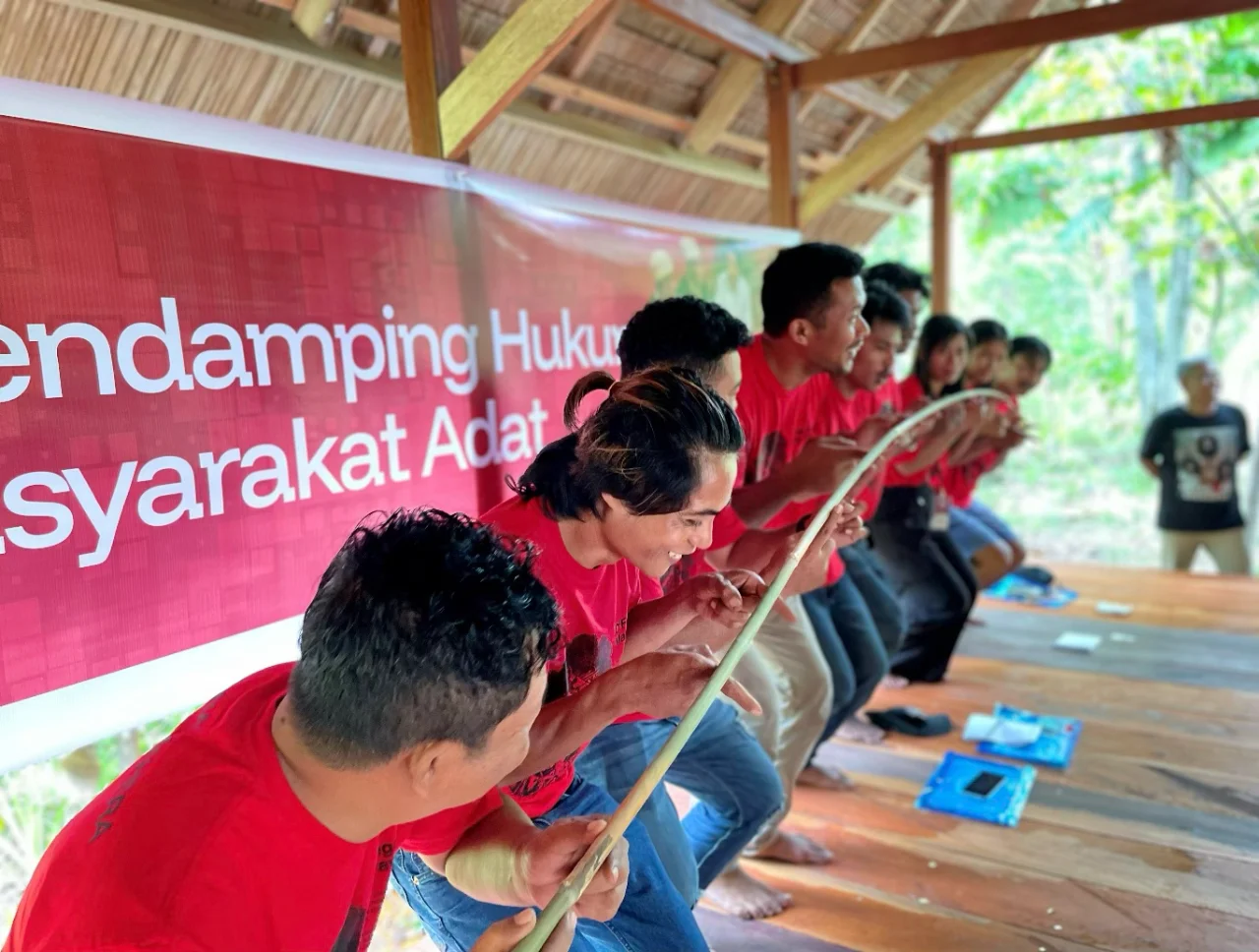
On the third day, participants arrived wearing bright red T-shirts provided by their friends at Fala Lamo. The atmosphere felt different from the previous two days: warmer, more confident. People who had been strangers three days earlier were now laughing together in a way that can only emerge from genuine solidarity.
Bang Alam opened the day with a broader perspective. As facilitator of the advocacy session, he did not begin with strategy or tactics. He began with a portrait of reality: what is the actual situation facing Indigenous Peoples in North Maluku today? One case after another was presented—not to frighten participants, but to help them see clearly that what was happening in their villages was neither an accident nor bad luck. It was a pattern. And patterns can be challenged once they are understood.
After Bang Alam came Dhany Alfalah, who guided participants into understanding the industrial system that had long operated beyond their sight.
North Maluku contains the second-largest nickel reserves in Indonesia. And Indonesia controls more than half of the world’s nickel reserves. The ore extracted from Indigenous ancestral lands does not stop at the port. It travels far: smelted, refined, transformed into battery components, and eventually installed in electric vehicles sold on other continents. Dhany asked participants to map this entire chain in groups, from the mining pit to the battery in the hands of global consumers. Then came the most piercing question of all: across this entire value chain, who receives the greatest benefit?
The answers that emerged from the discussions were unsurprising, yet still painful to hear spoken aloud.
Bang Rais returned to facilitate a session on social analysis. He introduced participants to a systematic way of understanding problems: identifying stakeholders, tracing historical roots, and examining the power structures that sustain them. Participants practiced a method known as problem-tree analysis, mapping a central problem as the trunk of a tree, its causes as roots, and its impacts as branches. A framework often taught over an entire university semester was practiced in a single afternoon inside an electricity-free saung.
The day concluded with what was perhaps the most technical yet most crucial session: the legal pathways available for the recognition of Indigenous Peoples under Indonesian law. There are eleven possible pathways. There is Constitutional Court Decision No. 35 of 2012, which affirmed that customary forests are no longer state forests. There is Ministry of Home Affairs Regulation No. 52 of 2014, which outlines mechanisms for local government recognition. There are critical distinctions between customary institutions and royal or sultanate structures that must be understood to avoid mistakes from the outset. For participants who had long felt that the law only worked against them, this session offered something rare: an opening, and a map for finding it.
The Thread That Stretched Between Them
In the dim glow of portable lamps surrounding the saung, Bang Jeff facilitated the development of action plans. Not grand, jargon-filled plans, but concrete steps that could begin in each participant’s village: documenting rights violations, tracing customary governance systems that may have been forgotten, and recording knowledge that had previously existed only in memory.
Then Bang Enal brought out a spool of thread and stretched it across the circle. He tossed it to one participant and asked each person to speak before passing it on. The thread moved from hand to hand, forming an increasingly intricate web in the center of the circle.
When the spool reached Ikal, I found myself holding my breath.
“I am proud to have participated in this program because I gained knowledge that I never received in school. One thing I hold firmly now is that I will return to my village and tell the entire community of Maba Pura that we must defend our land. We must not allow ourselves to be trampled on our own land.”
I remembered how he had stood on the first day. Trembling hands. A cracking voice. That night, his voice was clear and his hands were still. Not because he had become someone else, but because something that had always existed within him had finally found its words.
The thread stretched among twenty people, creating an image that was both accidental and perfectly fitting: a community now connected by shared knowledge.
Outside the saung, the sound of the waves from Waybibil Beach grew louder. Inside, some participants were reluctant to leave. There were plans to watch a movie together. Conversations remained unfinished. Something had just begun.
The next morning, our paths diverged. The facilitators would travel through Sagea, taking a route an hour longer through the IWIP mining area in Weda. The participants returned to their respective villages, to territories whose nickel reserves are coveted by global corporations. They did not return as legal experts. They returned as people who understood that they had rights—and that those rights were worth fighting for.
During the long, winding journey home, I tried to sleep. But this time, I found it difficult to close my eyes. I kept thinking about Ikal, and about the spool of thread that had formed a web in the middle of that electricity-free saung the night before.
Perhaps the best method is not the most sophisticated one. It is the one most honest about who is learning, and why they need to learn.
Participants of the People’s Legal Advocacy School at Fala Lamo, Bicoli Village, East Halmahera, during a group discussion session. This region is home to some of the largest nickel reserves in Indonesia.


0 Comments
Leave a Reply