

His left hand waved. His right hand poked at slices of papaya with a fork.
Her name is Trisminah. I met her at the breakfast table of the University Club Hotel, on the morning before the first session of the Critical Legal Studies School began. Her smile was warm. But I knew very well, from HuMa’s visit to her farmland a month earlier, that she had not come to Yogyakarta for a picnic. Back then, her eyes were bruised, her appearance disheveled. A farmer from Batang whispered to me quietly: she seemed emotionally unstable.
Mbak Tris is a farmer from Kendal who also works as a people’s lawyer. The Central Java Regional Police have summoned her three times for clarification regarding a land dispute in her village. She came to Yogyakarta with a mission of her own: to discuss her case directly with the professors who would be teaching the nine sessions over two days. At the same time, she wanted to sharpen her argument that the summons had no legal basis, since the reported incident occurred in 2014 and had already exceeded the statute of limitations.
She quickly excused herself and hurried toward the event hall.
***
The night before, an online motorcycle taxi carried me from the train station toward Jalan Colombo, right at the intersection leading to UGM, UNY, and UIN. Nearby was Gejayan, the site of the iconic “Gejayan Memanggil” movement. The sky had only recently turned dark after a week of relentless heat without rain. The driver leaned forward, occasionally wiping his map screen. “This is unusual, Sir. It’s been hot for a whole week,” he said.
I used to pass through these streets often. Sometimes on my way to discussions and organizing meetings at UGM, sometimes simply to buy Ayam Preksu or Mie Gacoan with friends. Yogyakarta holds every kind of romance for those who have lived there. During my university years, discussion forums and educational gatherings outside campus could be found on nearly every corner. Regular demonstrations on certain streets felt like fixed appointments. The doctrine shared among friends was simple: think about how to improve the nation. Read, write, discuss. And when you’ve had enough, take to the streets.
Even now, when meeting old friends, only two greetings still matter: “What book are you reading?” and “Where is your latest writing?”
That is why I was initially skeptical when I learned there was a registration fee for this Critical Legal Studies School: one hundred and fifty thousand rupiah for online participants and three hundred thousand for in-person attendees. It felt unusual for the tradition of small discussion circles in this city.
But I was wrong. By the end of registration, 124 people had expressed interest. The organizers reopened registration several times to accommodate the overwhelming enthusiasm. Was it because of the material? Because the speakers were widely respected? Or simply because it was Yogyakarta? Let that remain a shared mystery.
***
The event took place over two days, from May 15 to 16, 2026, at the University Club Hotel, UGM. Forty participants attended in person, while twenty joined online. They came from diverse backgrounds: practitioners, lawyers, academics, students, and affected community members. Some did not even have legal backgrounds, such as Fani, who studies the philosophy of economics and was interested in comparing it with the philosophy of law.
Yance Arizona, Chair of Pandekha and Chair of the Asslesi Presidium, opened the event by sharing that he himself was a product of critical legal education, having attended programs organized by HuMa since the early 2000s. The organizers then asked me to step forward on behalf of HuMa’s Executive Coordinator, who was still traveling after being hospitalized since one o’clock the previous morning. I was slightly surprised and nervous, but I conveyed what I believed was most important: critical legal learning is both a body of knowledge and a disposition. So that when participants return home—as lecturers, students, practitioners, or affected communities—they will at least be able to maintain a critical stance toward policies that cause suffering for ordinary people.
***
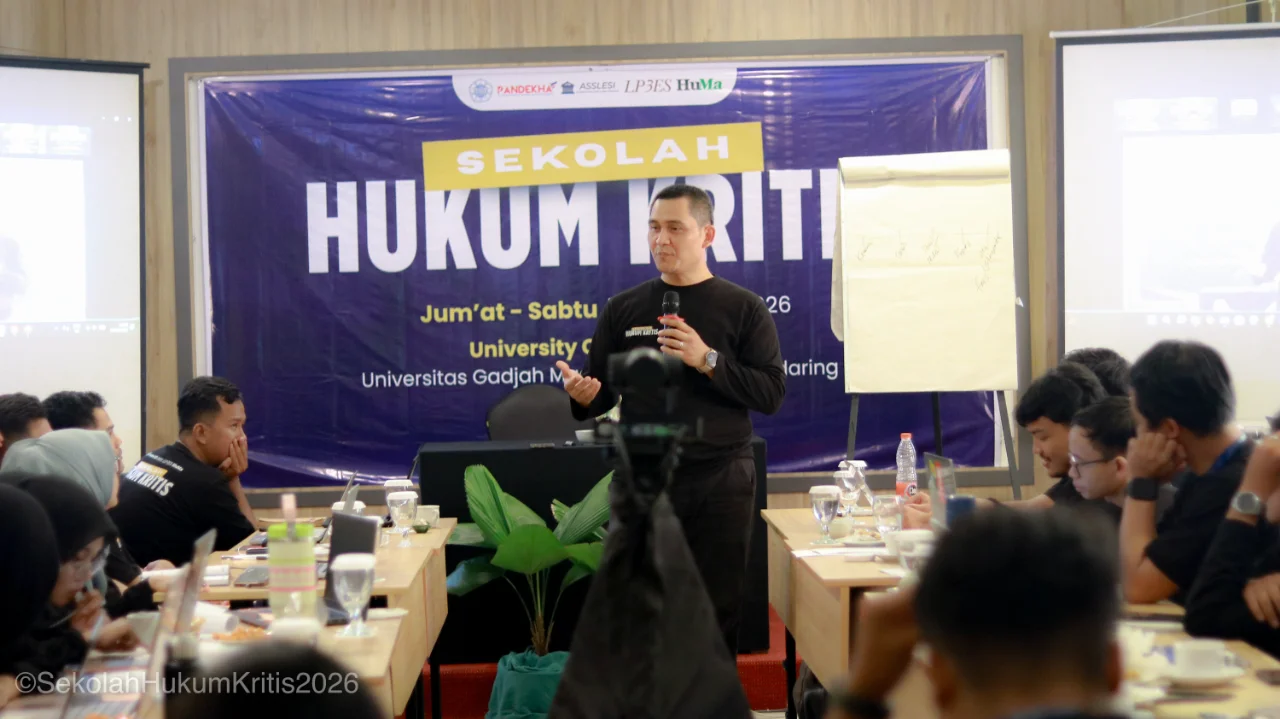
The first session belonged to Prof. Dr. Widodo Dwi Putro, affectionately known as Mas Wid. Before beginning, he asked all participants: “How do you understand critical legal studies?” The room responded with various interpretations, and I listened as Mas Wid patiently wove them together.
The philosophy of critical law, he explained, emerged through a transformation: from natural law to legal realism, eventually becoming a school of thought that critiques positivism. It challenges law from social, political, and economic perspectives. Law on paper does not necessarily align with its implementation. “Take sexual harassment cases, for example,” he said. “Legal realism does not only look at the case itself, but also at the composition behind the law: do female law enforcers have more influence than male ones?”
Critical Legal Studies goes even further: it does not stop at examining law as it actually operates but seeks to transform unjust law. In this view, law is a reflection of the interests embedded within an economic system. Mas Wid used Yogyakarta’s own feudal system as an example: there is no private land ownership; all land is Sultan Ground, and marriages among nobles served to secure property as well as military strength. “Only at the very bottom are ordinary people, who merely possess cultivation rights.”
I noticed nearly every participant raising a hand. Mbak Tris was one of them.
She voiced what had perhaps been circulating in her mind for years: if law is supposed to be true, just, and proper, yet she and her people’s organization have personally experienced the consequences of unjust legal products, then how does one fight legalized injustice? And what should serve as the reference point when legislation and court decisions contradict one another?
Mas Wid suggested that the discussion continue informally during dinner.
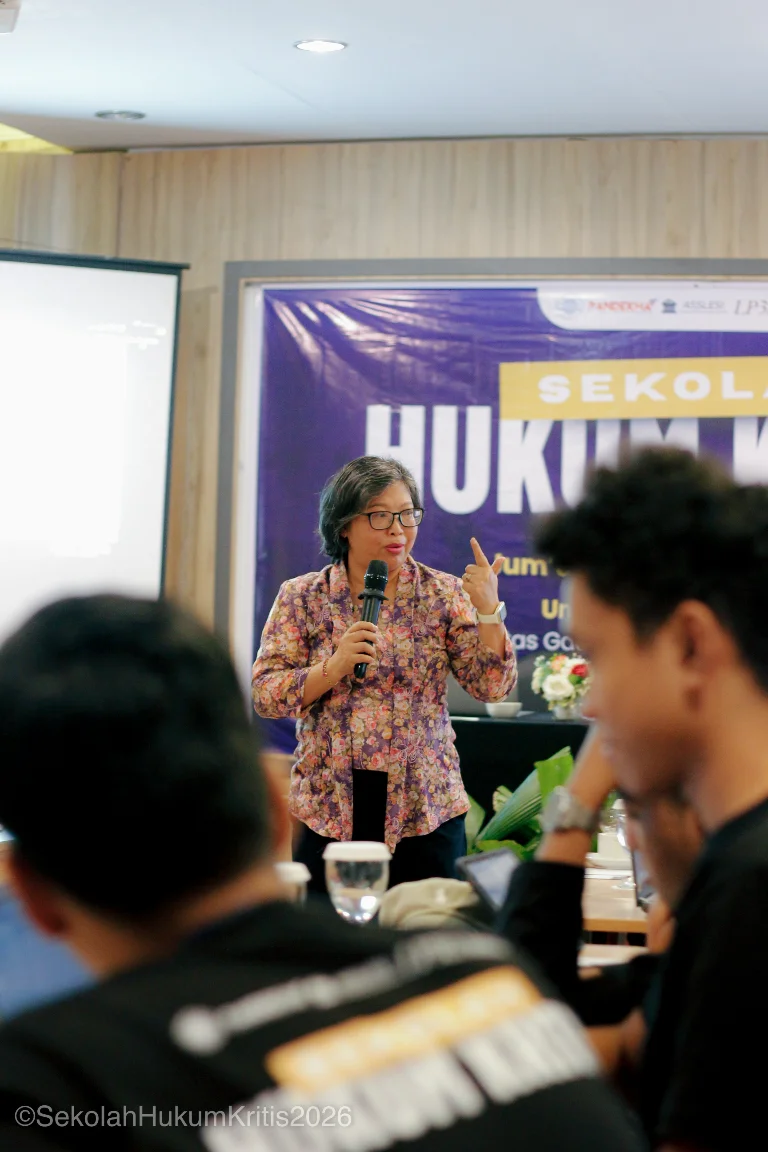 In the next session, I listened as Prof. Dr. Sulistyowati Irianto emphasized something that sounds simple but is often forgotten: law is not merely legislation. Law is an anthropological and sociological document that lives within society. “How do we question not the law itself, but the way the law works? Are legal subjects positioned in ways that accommodate the realities of lived experience from below?”
Because this approach borrows methodologies from other disciplines, Bu Sulis is often labeled as someone whose socio-legal studies are not truly legal studies. I wrote this down: the question remains a legal question, but the method of reading is one that is more honest about reality.
Agung Wibowo entered the discussion through Marx, but not through theory. He began with Marx’s life: why the work emerged in the first place. The context of 1818, the Industrial Revolution and the chaos it produced. The collapse of the feudal system in France in 1789. The domestication of women. Class struggles. “The prerequisite for studying Marx,” he said, “is class consciousness. Our basic foundation is class consciousness, then we recognize reality. Reality becomes the ground on which we stand.” In the Marxist tradition, law is a reflection of the economic base. And because hegemony exists, contradictions must be confronted.
The final session of the first day was delivered by I Gusti Agung Made Wardana, who presented the eight planetary boundaries humanity is currently violating, from biosphere integrity to climate change. There are two possible futures for Earth: a Hothouse Earth with temperatures four degrees Celsius higher, or a Stabilized Earth that can still be saved. “We’re already at one and a half degrees, and we’re already complaining about the heat. Imagine four degrees. Who do you think would survive?” I had no answer.
***
The next day, May 16, 2026, the map on my phone glowed red: severe traffic congestion throughout Yogyakarta due to a long holiday weekend. The motorcycle taxi driver chose a detour to avoid getting trapped near Malioboro. We arrived at Tugu Station in less than twenty minutes.
Every seat in the waiting area was occupied. People sat on the floor, including me and a friend. I asked him how it felt to come to Yogyakarta without actually vacationing around the city. He responded with his trademark cynical smile, then told me he had been caught in the rain the previous evening while walking around Malioboro.
The train we boarded to Jakarta was the most expensive class available. The atmosphere felt like a scene from Titanic: seats that could be transformed into beds, attentive attendants, hearty meals of smoked beef, snacks, and bottled water. When my pencil fell and I had just bent down to pick it up, a staff member was already faster.
“Here you are, Sir,” she said, smiling with narrowed eyes.
That morning, the rupiah exchange rate had already reached Rp17,600 per U.S. dollar.
News stories flooded my phone screen. President Prabowo delivered a speech:
“The rupiah is like this, the rupiah is like this, so what? Well, the dollar is like this. People in villages don’t use dollars anyway. Food is secure, energy is secure. Many countries are panicking, Indonesia is still doing fine.”
I nearly choked.
Did he not understand the relationship between exchange rates and rising food prices in rural areas? Or was this a strategy to dampen public frustration? I recalled Agung Wibowo’s session: the economic base shapes the superstructure, including the way rulers speak to the people. I remembered the second day’s sessions: five presentations on impunity and injustice, feminist legal theory in the context of GEDSI, critical discourse analysis, legal reform movements, and Indigenous peoples. And most vividly, Yance Arizona’s session: colonialism is not merely about colonizers who have gone home. Its logic is still practiced today and has been inherited directly by Indonesia’s legal system.
“More than sixty percent of Indonesia’s land area is considered state property. That very much reflects a colonial character.”
I remembered Mbak Tris with her fork and papaya at the breakfast table. I remembered the farmers whose land had been seized, the children going hungry, the communities facing criminalization. None of that chaos happened without a cause.
The lights in the train carriage gradually dimmed. A faint snore could be heard from the seat behind me.
I sent a brief farewell message to Mbak Tris. Not long afterward, the event’s WhatsApp group became lively with photos of participants together after the official closing. It seemed they were already prepared to return to reality as it truly is.
From somewhere in the distance, a single word echoed.
Fight.


0 Comments
Leave a Reply