

[Clap clap clap… wheeeew… wheeeew…]
The sound of enthusiastic applause echoed through the writing class every time a participant finished reading their piece.
Rais suddenly chimed in, “You all sound like poets now—your writing is full of poetic language.” The room immediately burst into laughter.
That morning, several participants took turns reading the pieces they had written. Frans from Papua read his article titled “Take the Wealth, Leave the Korowai to Suffer.” The piece tells the story of how communities there have been affected by illegal gold mining.
Picking up where Frans left off, Accung read a piece describing an engaging learning method he experienced while studying alongside the people of Rancapinang last month. His work, titled “A Learning Reflection: Discovering Joy Through Learning Together,” was woven together with metaphors that were pleasant to hear—at least to me.
As for myself, I wrote about my month-long stay in Pundenrejo Village, Pati, at the end of last year. Titled “The Wounds Left Behind by a Land Dispute,” the piece simply sought to tell the story of two women living with the trauma of repeated violence.
These were the writings produced as assignments from the writing class we were attending. For a moment, I smiled to myself. We, who are more accustomed to shouting slogans like “Long live the people!” or “Fight the oppressive government!” apparently had it in us to become poets after all.
Weaving Words in the Training Room
Rolled pandan pancakes, spicy cassava chips, and Solo-style risoles were neatly arranged on a table outside the meeting room. Several people were busy making coffee to bring inside, preparing for the learning sessions ahead. In the Kijang Room of Ibis Style Bogor Raya Hotel, the writing workshop was held from June 3, 2026, and continued for the next three days.
At exactly 10:00 a.m., the class began. That day, I joined fifteen other participants in the training room. The workshop was attended by staff members of HuMa and several partners from different regions. Some came from Bogor, West Kalimantan, North Kalimantan, South Sulawesi, Central Sulawesi, and even South Papua.
This time, Fahri and Viriya facilitated the training. Both are journalists and editors at Project Multatuli.
Fahri opened the class with introductions. The purpose was not merely to learn each other’s names and places of origin, but also to understand what everyone was currently working on within their respective organizations. He admitted that spending too much time behind a laptop editing articles from journalists and contributors meant he often only knew grassroots stories through the words submitted to his desk. Today, he wanted to hear those stories firsthand. One by one, the participants introduced themselves.
The introduction session continued with a review of pieces participants had submitted beforehand. Volunteers stepped forward to read their work aloud as discussion starters. This session invited everyone to reflect on what they had previously written. One by one, participants’ articles were displayed on the projector screen.
Every time someone finished reading, the others were asked to provide comments. Throughout the reflection process, Fahri and Viriya inserted fundamental lessons about writing.
The atmosphere gradually transformed. The room became lively with discussion. The tension and awkwardness that had initially lingered slowly melted into enthusiasm. The training room became a laboratory of creativity.
Participants who had initially been hesitant to comment began offering critiques wrapped in laughter and encouragement. Every note from fellow participants and mentors became another step on the staircase toward becoming better writers.
This reflection exercise proved to be an effective method for identifying the strengths and weaknesses of each piece. At the same time, the corrections and suggestions became valuable lessons for future writing.
The sun was already leaning westward when the first day’s session neared its end. Fahri assigned a new task: write an entirely new piece. The instructions were simple: write 300–500 words in any format you like. The assignments would be read aloud on the second day.
Closing the first day, Fahri left participants with one final message:
“In writing, character matters. Add personal experiences and scenes to strengthen the story.”
When Data and Experience Come Together
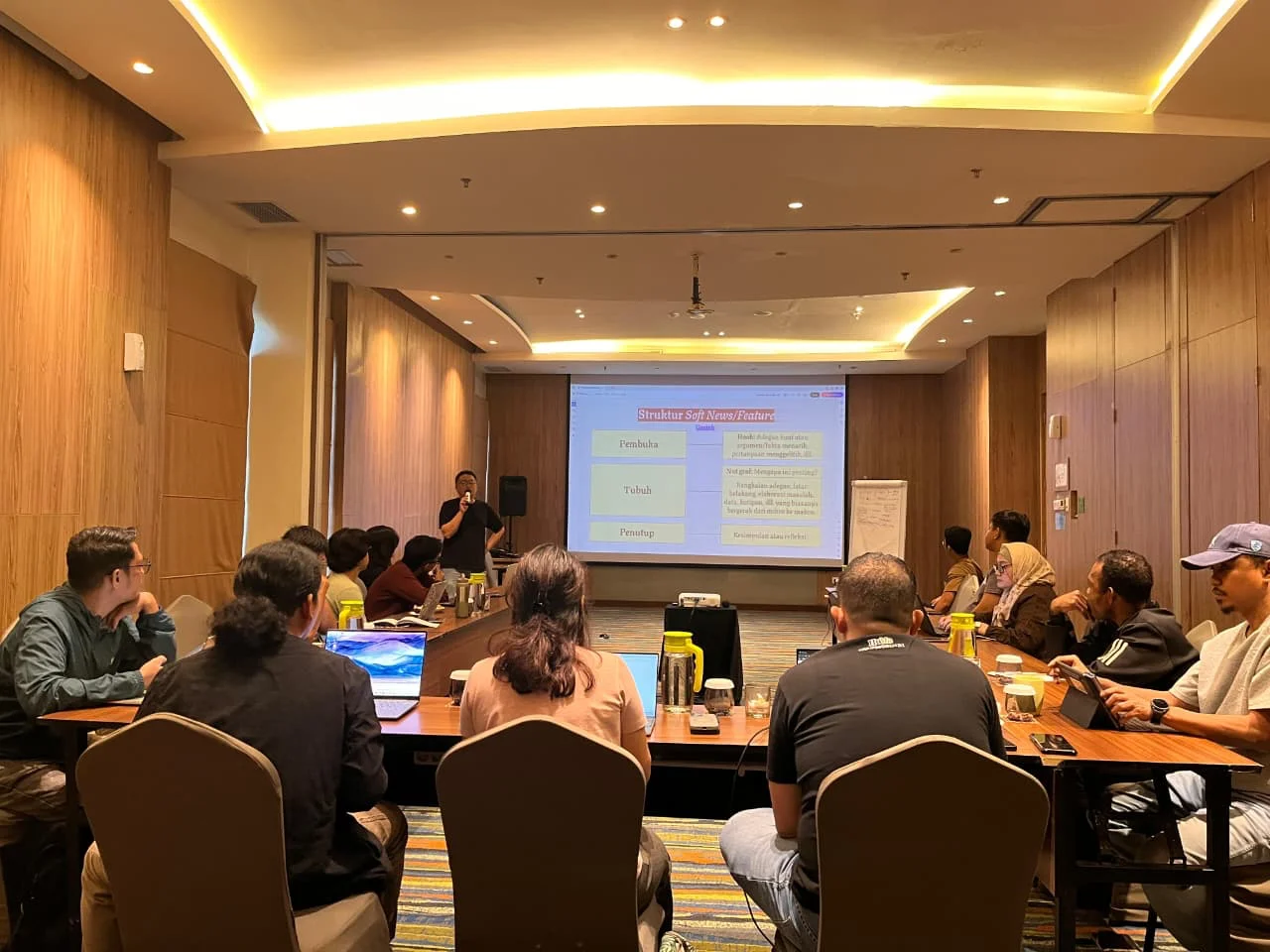
The projector screen was already glowing when I entered the training room. Several participants had already opened their laptops. This was our second day of training. As scheduled, class began at 10:00 a.m. This time, Viriya facilitated the discussion. The method remained the same: reflecting on written work, except now the pieces were newly written overnight.
Sukirman from North Kalimantan became the first participant to read his work. The others listened attentively and offered feedback once he had finished.
I immediately noticed a difference compared to the pieces read on the first day. They were not yet at the level of Andreas Harsono or Chatib Basri, but the lessons from the previous day had encouraged participants to begin truly telling stories through their writing.
The class became even more animated as the writing grew increasingly poetic. Frans with “Take the Wealth, Leave the Korowai to Suffer,” Accung with “A Learning Reflection: Discovering Joy Through Learning Together,” and me with “The Wounds Left Behind by a Land Dispute” quickly earned us the nickname of poets from the other participants. Pretending to be poetic despite having only modest writing skills—that was the joke.
Playful teasing filled the room, a sign that the learning environment had become more comfortable and engaging. We were no longer awkward around one another. We had become honest.
The next session was led by Viriya, followed by Fahri in the afternoon. Two main dishes were served at today’s learning table: data-driven opinion writing and feature writing.
From Viriya, we learned how to tame numbers and data into compelling arguments. She shared the process she used when writing an opinion piece about the nickel oligarchy. The first step, she explained, was determining the central question the article sought to answer.
Her advice was simple: “One article, one question.” The goal is to keep a piece focused rather than allowing it to wander in multiple directions and confuse readers.
In addition to writing techniques, Viriya also shared methods for investigating data. Participants eagerly experimented with various approaches, from examining mining concession maps through the Ministry of Energy and Mineral Resources portal, to processing data in Excel, to searching company documents in order to understand corporate profiles.
Finally, she emphasized that data-driven opinion pieces should present findings through compelling visualizations.
The key lesson from this session was learning how to transform cold data into persuasive arguments. We learned that strong opinion writing requires a foundation of credible evidence so that it does not sound like mere complaints. The final session of the second day was facilitated by Fahri. Here, we learned the art of storytelling. In journalism, this is known as feature writing.
The classroom atmosphere softened as the discussion shifted toward feature writing. If opinion writing is about sharp thinking, feature writing is about emotional depth. This is where a piece of writing is given its soul.
In simple terms, feature writing presents information in a creative and engaging way by weaving stories into the narrative. Human-centered storytelling and human-interest perspectives become the strength of a feature article, regardless of its subject matter. Feature writing helps a piece become not only informative but also transformative.
“Remember, we represent the ears, eyes, nose, senses, and emotions of the reader. The voice of your story helps bring distant issues closer and makes them easier for others to understand,” the mentor said as he concluded the afternoon session.
Dissecting Cases and Building the Anatomy of a Story
The final day was crucial: constructing outlines based on real-world case studies. It is often considered the most tedious part of writing, yet it frequently determines whether a piece succeeds or fails.
“For a writer, writing without an outline can lead you astray halfway through the journey. Eventually, you no longer know where you’re headed,” Viriya began.
The challenge started immediately. The first task was not to write beautiful sentences, but to create an outline. Participants were asked to imagine themselves as editors at a media outlet. On their desks lay a contributor’s draft outline. Their task was to revise and improve it.
Fingers danced across keyboards. Everyone focused intensely on their screens, reading every line carefully. Around them, the atmosphere created a contrasting soundtrack: the constant tapping of keys formed a familiar symphony of concentration.
Before we realized it, thirty minutes had passed. Viriya instructed participants to present their revised outlines. This time, not everyone volunteered. Only a few participants chose to share their work.
The second task divided participants into four groups. Each group selected an advocacy case they were currently working on and was asked to create a complete outline for an article.
The exercise forced everyone to think logically: How should the article open in a compelling way? How should arguments be structured so readers remain engaged? How should the piece end with a lasting impact?
Each group began discussing their chosen case and constructing an outline. In one corner of the room, three participants scribbled key points onto a large sheet of paper. Other groups preferred discussing ideas before typing them into a laptop.
The mentors gave everyone one hour. Afterward, each group presented their work. Then came the moment of truth. Each group stood before the class to explain its outline. Mentors and fellow participants immediately challenged them with critical questions: “Why isn’t there any legal analysis?”,“The opening is too ordinary. Phrases like ‘toll road’ or ‘red carpet treatment’ are overused—find something else.”, “Where’s the data? That’s important.”, “Where is the climax of this story?”
The flood of criticism did not dampen the mood. On the contrary, the room came alive with laughter and logical debate. That was the exciting part. Outlines were dismantled, reconstructed, and refined together until their structure became truly solid.
One participant sighed:
“It’s surprisingly difficult to remove unnecessary data. We often feel that everything should be included because it seems too valuable to leave out.”
“That’s exactly why we create outlines,” Viriya replied. “They help keep a story focused and prevent it from wandering in every direction. An outline stops us from being tempted to include information that isn’t necessary.”
As the afternoon approached, the complex case studies had transformed into clear roadmaps ready to be developed into complete articles.
To close the three-day workshop, each participant was invited to share their impressions and reflections. The mentors did the same. The sentiment was unanimous: the training had provided valuable lessons and practical tools for becoming better writers.
“This is the first writing workshop I’ve ever attended,” said Rais, the final participant to speak. “It wasn’t what I expected. I thought it would be filled with lectures, but instead we spent most of the time practicing. That made it much easier for me to understand.”
As a mentor, Fahri ended with one final reminder: Keep practicing. Good writing does not come from talent alone. It comes from a skill that is continuously sharpened.
The workshop concluded with a group photo. A new enthusiasm radiated from the participants’ faces. The enthusiasm to begin writing—to carefully arrange word after word until they form a meaningful story.


0 Comments
Leave a Reply