

“I draw a straight line. It’s simple, I just hope we stand straight to defend our territory and forests, don’t let them be taken by others.”
Nety said those words while showing her drawing to me. She is one of the Dayak Agabag women I met in Kalun Sayan Village on a Tuesday morning at the Village Meeting Hall. It was our first meeting. We gathered with twenty others from Salang Village, Tembalang Village, Tinampak I, and Tinampak II to attend the People’s Legal Aid School.
To reach where Nety was standing, our group had to go through a journey that was not just a change in distance, but a test of patience cutting through the Kalimantan forest bordering Malaysia. At the northern tip of Indonesia, precisely in Tulin Onsoi District, Nunukan Regency, North Kalimantan, lies Kalun Sayan Village.
***
The journey began from Tarakan. Accompanied by Rais, Solihin, Nico, and Iyan, the speedboat’s hull started to cut through the waves towards Nunukan. After three hours, we arrived at Liem Hie Djung Sea Border Crossing Port in Nunukan.
Before we could step out of the port, Rais’s phone rang. It was Darwis calling.
“Where are you, bro? Don’t come out of the port, I’ll pick you up directly using a boat,” Darwis said.
Darwis is a local youth working at the Green of Borneo institution. He arrived with a small boat that could only fit six people. The boat sailed, and the blue sea slowly turned into dark brown as it entered the labyrinth of waters known as Snake River.
For almost an hour, we passed through the dense mangrove green walls on both sides of the river. Occasionally, we encountered border area guard posts manned by soldiers. Since ancient times, the river has been the main road for the people there. Before the asphalt came, water had already connected villages to villages.
To reach the Snake River port, we even had to pass through Malaysian waters. No wonder the flag displayed at the guard post was not red and white.
As our feet touched the Snake River port, the mode of transportation switched to a car. The journey continued on the road for about three hours. The road was already asphalted and relatively comfortable, although we had to occasionally avoid small potholes scattered in some areas. But what caught our attention the most was not the road itself, but the views on both sides. As far as the eye could see, stretches of oil palm plantations spread endlessly.
The trees stood in almost perfect rows, like an army that never finished following orders under the development regime’s command. Amidst that uniform expanse, the villages only appeared as small dots, as if trying to remind that long before the palm oil came, life had already grown in this place.
Entering Kalun Sayan Village, several signs stood by the roadside. Their message was simple yet firm: “This Forest Belongs to the Dayak Agabag Indigenous Community.”
After hours of being shaken on the bumpy roads, the natural landscape gradually sloped down. The fatigue and tension during the journey instantly disappeared as the entrance gate of Kalun Sayan Village came into view. The local wooden houses were neatly lined up. In this village, life flowed with a calm yet warm rhythm.
***
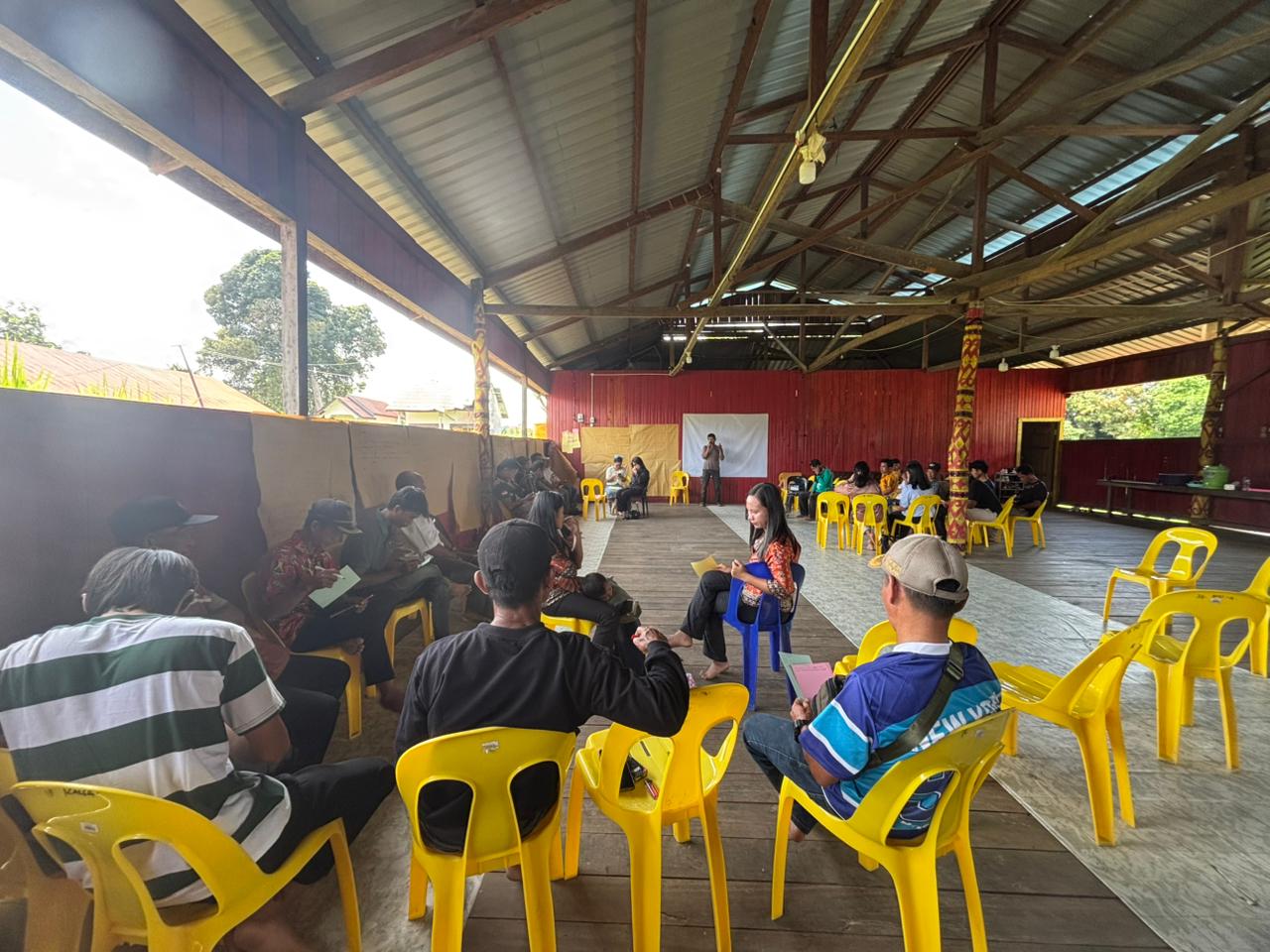
Together with local community leaders, we prepared for a three-day event: the People’s Legal Aid School. Usually, this event is filled with dense legal materials from our school modules. But this time, it was a bit different. Legal issues were still addressed, but not about the theory anymore, rather about what can be given and taken by using the law.
In essence, this school aimed to invite participants to rethink what they do not want to let disappear from their village and how they can defend it.
The classroom started by discussing what “law” means according to the participants themselves. Some said it’s “something that must be obeyed,” some said it’s about “what can and cannot be done,” and some said it’s “compulsory rules.” All were correct.
Using simple language, the facilitators slowly went through page by page of the state regulations, bridging the gap between formal law in the capital and customary rights living in the heart of the village. For indigenous communities, forests and lands are not just natural landscapes that can be marked on a map or mere groups of trees. They are part of their history and heritage passed down from one generation to the next. Forests and lands are the nurturing mother that provides them with food, medicines, and cultural identity. However, without a legal document from the state, their living space is vulnerable to erosion

0 Komentar
Tinggalkan Balasan